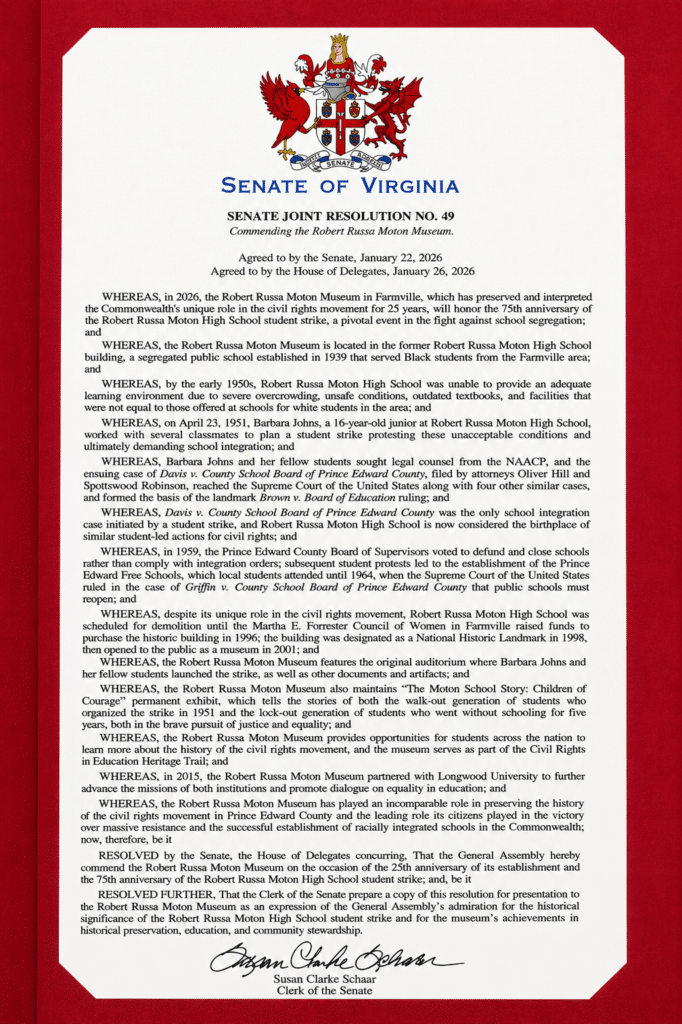
The Virginia General Assembly has formally commended the Robert Russa Moton Museum as the museum marks two major anniversaries in 2026.
Senate Joint Resolution 49 recognizes the 25th anniversary of the museum’s establishment and the 75th anniversary of the April 23, 1951, student strike at Robert Russa Moton High School.
The Virginia Senate agreed to the resolution on January 22, 2026, followed by the House of Delegates on January 26. With its passage, the General Assembly formally recognized Moton’s history and ongoing work in the legislative record of the Commonwealth.
From Moton High School to the U.S. Supreme Court
On April 23, 1951, 16-year-old Barbara Rose Johns and her fellow students walked out of Robert Russa Moton High School to protest overcrowding and the unequal conditions they faced in their segregated school.
Their protest quickly grew beyond the walls of Moton.
After the students sought legal assistance from the NAACP, attorneys Oliver Hill and Spottswood Robinson filed Davis v. County School Board of Prince Edward County. The case eventually joined four others before the U.S. Supreme Court in Brown v. Board of Education. On May 17, 1954, the Court ruled segregation in public education unconstitutional.
In Prince Edward County, however, resistance to desegregation continued.
Rather than desegregate its schools, county officials chose not to fund the public school system. Public schools remained closed from 1959 to 1964.
Those five years changed lives across Prince Edward County. Teachers lost jobs. Families searched for ways to educate their children. Some students left the county to attend school elsewhere. Many Black children lost years of formal schooling.
In 1963, after four years without public schools, the Prince Edward Free Schools opened and provided free education during the 1963–64 school year. They offered an important educational opportunity for students, but they were separate from the county’s public school system, which remained closed.
In 1964, the U.S. Supreme Court ruled in Griffin v. County School Board of Prince Edward County that the public schools must reopen, ending five years without a public school system in Prince Edward County.
The Moton story holds both generations: the students who walked out in 1951 to challenge unequal education and the children who were later locked out of public education during the five-year school closings.
Saving the Place Where the Story Began
Years later, the former Moton High School faced another uncertain future.
With the building scheduled for demolition, the Martha E. Forrester Council of Women led the effort to save it, raising funds to purchase the historic school in 1996.
Moton was designated a National Historic Landmark in 1998 and opened to the public as the Robert Russa Moton Museum in 2001.
In 2015, the museum entered into a partnership with Longwood University, bringing together two institutions with deep connections to Prince Edward County’s educational history. As recognized in SJ 49, the partnership works to advance the missions of both institutions and promote dialogue on equality in education.
Visitors today can still stand inside the original auditorium where Barbara Rose Johns and her classmates gathered on April 23, 1951.
Through the permanent exhibition, The Moton School Story: Children of Courage, the museum shares the experiences of the walk-out and lock-out generations. Its collections, educational programs and community engagement continue that work, connecting new generations with the people and events that shaped this history.
A Milestone Year for Moton
Senate Joint Resolution 49 comes as Moton commemorates two milestones rooted in that history: 75 years since the 1951 student strike and 25 years since the Robert Russa Moton Museum opened to the public.
On July 25, the museum welcomed members of the Moton Museum family, descendants, community members, friends and supporters for the Moton Family Reunion. The gathering brought generations together inside the historic school to reflect on the people, experiences and community that shaped Moton’s history.
The General Assembly’s resolution recognizes those same anniversaries while looking across the larger Moton story—from the courage of students in 1951 and the struggle for educational equality that followed, to the preservation of the historic school and the work of the museum today.
In its closing language, the General Assembly commends the Robert Russa Moton Museum and expresses admiration for the historical significance of the student strike and the museum’s achievements in “historical preservation, education, and community stewardship.”
Seventy-five years after Moton students walked out of their school, and 25 years after the historic building opened as a museum, Senate Joint Resolution 49 honors the generations behind that story—the students who stood up, the families who supported them, the children who endured five years without public schools, and the community members who fought to preserve the place where it began.
Their history lives here. The work of preserving it continues.
Read the Resolution
Want to take a closer look? Read the full Senate Joint Resolution 49: Commending the Robert Russa Moton Museum.
Read Senate Joint Resolution 49 →