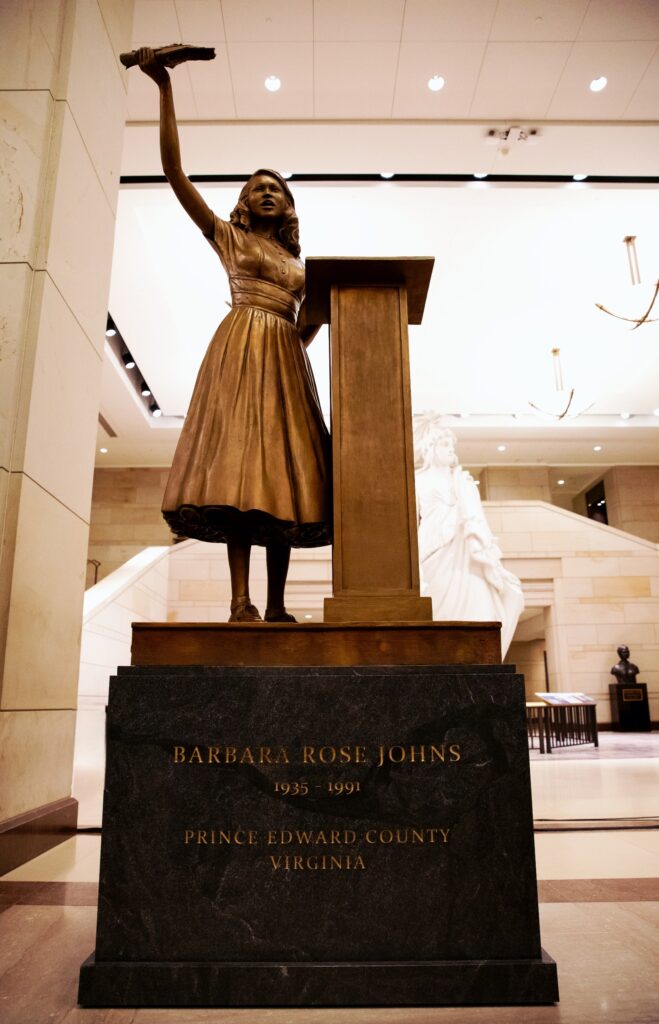
The bronze figure holds a tattered book in her outstretched right hand. Her mouth is slightly open – in the closing arguments of an impassioned speech to her classmates, urging them to join in a protest against an unjust educational system.
That moment, the strike that followed as 450 of her classmates followed 16-year-old Barbara Rose Johns out of Robert Russa Moton High School that morning, and the lawsuit that followed – which became part of the Brown v. Board of Education decision – changed the course of American history.
On Tuesday, a statue of Barbara Johns was unveiled and dedicated in Emancipation Hall within the U.S. Capitol as the newest addition to the National Statuary Hall Collection, two statues from each of the United States that represent pivotal figures in their history. Johns joins George Washington as Virginia’s representatives.
“Barbara Johns’ courage and example was all in service,” said Virginia Gov. Glenn Youngkin in remarks at the dedication. “Service of a noble mission to ensure that all Americans would receive an excellent education. This statue is a fitting memorial and tribute to a teenager in Virginia who became an American hero. A hero whose courage inspired a nation to overcome injustice and to more fully realize our founding promise as a nation. And now this fitting memorial has a fitting home.”
Speakers at the Tuesday ceremony extolled the courage and heroism of Johns, calling her an icon of American history.
“Barbara’s now famous walkout from her school in Farmville, Virginia, symbolizes something profoundly American: the power of the individual,” said Speaker of the House Mike Johnson. “In Barbara, a farmer’s daughter from humble means, we see an ordinary citizen who challenged the injustices of her day, whose actions drew this nation a little closer to her founding ideals.”
“It is appropriate and important to elevate transformational trailblazers like Barbara Rose Johns,” said Minority Leader Rep. Hakeem Jeffries.” A story as powerful, a story as moving, and with this honor, a story that will never be erased. This statue of her will now stand in the Capitol, joining Rev. Dr. Martin Luther King Jr., Rosa Parks, and other iconic heroes, depicting her call to action as a reminder of the progress that we have made in this great country, and the work, of course, we must continue to do.”
In 1951, Barbara Rose Johns led a secret committee of fellow students at segregated Robert Russa Moton High School in Farmville Virginia to plan a protest of conditions at their school. Appalled by the state of their school – which had several buildings covered in tar paper to handle the crowded classes – the students gathered in Moton’s auditorium one morning. Johns gave an impassioned speech calling for her fellow students to join her in a strike, and they walked out of the school.
Johns and other student leaders sought counsel from Rev. Francis Griffin, a Farmville civil rights leader known as “The Fighting Preacher,” who put them in contact with NAACP lawyers Oliver Hill and Spottswood Robinson. Hill and Robinson agreed to represent the students on the condition that they challenge the system of segregation. The students agreed, and the lawsuit that followed became one of five cases combined into Brown v. Board of Education, which in 1954 declared segregated schools unlawful. Prince Edward County residents made up 75 percent of the plaintiffs in the Brown decision.
Following the Brown decision, Prince Edward County joined in what was known as “Massive Resistance,” an effort to defund public schools rather than integrate. Prince Edward County Public Schools were effectively shuttered for five years until another court decision forced them to re-open.
Because of family fears for her safety, Johns moved to Montgomery, Alabama to live with her uncle, civil rights leader Rev. Vernon Johns. She settled in Philadelphia and worked as a school librarian until her death in 1991.
“We knew her as Barbara Powell: minister’s wife, mother, librarian,” said Terry Harrison, Barbara’s daughter who spoke at the statue dedication Tuesday. “But the core of who she was as a 16 year old remained. She put God first in her life. She was brave, bold, determined, strong, wise, unselfish, warm, and loving. She led by example, inspired, motivated, guided, encouraged and championed family, friends, and strangers. We are truly grateful that this magnificent monument to her story, the sacrifices that her family and her community made, may continue to inspire and teach others that no matter what, you too can reach for the moon.”
In April 1951, Tuesday’s ceremony would have seemed an impossible outcome when the 450 Moton High School students walked out of the auditorium, led by Johns, on strike in protest of their school’s abject conditions. How could it be possible that nearly 75 years later, legislators and dignitaries from across the nation would gather together to dedicate a statue of the teenage girl from Prince Edward County?
The answer lies in decades of work and dedication on the part of family members, fellow strikers, and victims of a five-year school lockout in Prince Edward to tell the story, establish the R.R. Moton Museum, and preserve its history.
“I often say that at Moton, we have the privilege of walking alongside the giants upon whose shoulders we stand,” said Moton Museum Executive Director Cainan Townsend. “We will never be able to fill their shoes, but serving as a conduit for their story is one of the greatest honors of our collective careers. When the Martha E. Forrester Council of Women helped save the Moton building, they had no idea what it would become—they only had their determination, hopes, dreams, and a task at hand. Similarly, Barbara Johns, when leading the famous strike, could not have imagined that she would help bend the arc of the moral universe toward justice.
As Thurgood Marshall once said, ‘The legal system can force open doors and sometimes even knock down walls, but it cannot build bridges. That job belongs to you and me.’ We build those bridges as a community, taking the story wherever it needs to be told—schools, nursing homes, college campuses, detention centers, prisons, and beyond. It took a village to get us to this point, filled with the spirit of Moton and the power of collective action.”
In 2001, the Robert Russa Moton High School building was opened as the Robert Russa Moton Museum, dedicated to preserving and telling the story of Johns, the Moton strikers and the years of civil rights struggle that followed during Massive Resistance. Today, the museum welcomes visitors from around the world, the Moton story is taught as part of the Virginia SOL curriculum, and the museum is being considered as a UNESCO World Heritage Site.
In 2015, the Museum entered into an affiliation partnership with Longwood University to advance the museum’s mission and work. Since then, students have taken part in historical research and analysis, the Moton story has been incorporated into coursework and studies, and set records for visitors.
“What a decade it has been. Joyful work together, replete with so many wonderful moments,” said Longwood President W. Taylor Reveley IV. “In this world’s universal crush of ambition, it was not an act of ambition in 1951 by Barbara Johns. Not for profit or honors, instead her stand was an act of prayer and providence. She stood for her friends, for her family. She stood for dignity, and for unalienable rights. She stood for liberty and justice for all. She stood because truth will set you free, and now for all time, she stands for Farmville and for Prince Edward. She stands for her generation. She stands for Virginia. She stands for our ideals and for America.”
In 2020, Virginia’s Commission on Historical Statues in the United States Capitol selected Johns to fill a vacancy and join George Washington as representatives of the Commonwealth. Johns was chosen from a list of more than 100 names that had been narrowed down to five finalists.
Maryland artist Steven Weitzman was selected to create the 11-foot-tall statue and worked with the Johns family and Moton Museum over the course of the next five years through several approval phases to bring the monument to reality.
The pedestal is engraved with words from Johns’ speech that April morning: “Are we going to just accept these conditions, or are we going to do something about it?”
The Barbara Johns statue will be permanently placed in the U.S. Capitol’s crypt, a room reserved for statues from America’s 13 original colonies.